Hey there, Suspension
If you’ve ever gotten behind the wheel of a car that feels like it’s glued to the road—even on twisty backroads or pothole-ridden city streets—you’ve felt suspension geometry working (whether you noticed it or not). And as someone who’s spent the last decade making parts for suspension systems, let me tell you: it’s way more than just shock absorbers or springs doing the heavy lifting. So, what actually is the purpose of suspension geometry? Let’s break this down like we’re chatting in my shop after a long day of pulling parts off the rack.
First, let’s get one thing straight: suspension geometry isn’t a random set of angles and parts thrown together to make a car sit right. It’s the entire framework—control arms, bushings, knuckles, struts, all the little links that connect the wheel hub to the chassis—engineered to balance three huge, often conflicting goals: safety, handling, and comfort. Yeah, I said “balance” because if you skew too hard on one, you mess up the other two. Let’s start with the one everyone cares about most: keeping the wheels in contact with the road, no matter what.
Think about it: when you hit a bump, your wheel doesn’t just jump up and down like a pogo stick (thank goodness). Suspension geometry controls exactly how it moves vertically, laterally, and even tilts. If that movement is off, half the tire might lift off the ground during a hard corner, or a pothole could yank the wheel to the side so bad you lose control. Last year, we had a customer come to us with a budget commuter sedan that kept pulling left on the highway—turns out their factory control arm bushings were shot, so the camber angle was way off. Camber, for the newbies, is that side-to-side tilt of the wheel (top leaning in or out). Too much negative camber (top in) during a turn and you’re only using half the tire tread; too much positive (top out) and straight-line traction sucks. Fixing the geometry with upgraded control arms tightened that angle up, and that pull was gone within a day. That’s the stuff we live for—fixing small, geometry-related issues that turn a scary drive into a safe one.
Next up: handling. When you carve a corner, you want the car to turn where you point it, not drift like a boat. That’s where things like caster angle come in. Caster is the forward/backward tilt of the steering pivot (like if you held a broom by the top and leaned it back). Positive caster (top tilted back) makes the steering self-center when you let go—perfect for highway stability, and it keeps the wheel from wandering on uneven pavement. We worked with a local track team last season that was complaining their road course car felt jittery at high speeds. We adjusted the caster and added a set of stiffer sway bar links (part of the geometry setup, by the way) that reduced body roll. Suddenly, their lap times dropped two tenths—small, but in racing, that’s the difference between winning and finishing mid-pack. The key here is that geometry doesn’t just make corners feel sharper; it makes the car predictable, so you can trust what it’s going to do before you turn the wheel.
But wait, I know what some of you are thinking: “I drive a grocery-getter, not a race car—does this even matter to me?” Totally fair, and that’s where the third big goal comes in: comfort. A lot of people think suspension geometry makes a car bumpy, but no—bad geometry is what makes a pothole feel like you hit a brick wall. Think about it: when a wheel moves over a bump, the suspension’s path (called the “control arm arc”) determines how much force gets transferred up to the chassis. If that arc is straight up and down, you feel every single pothole. If it’s calibrated to shift a tiny bit forward when the wheel rises, that takes some of the impact force and redirects it, so it doesn’t jolt the driver or the passengers. We do a ton of work on daily drivers and SUVs, and a lot of their complaints about a harsh ride can be traced back to worn geometry components. Last year, a client brought in a family minivan that made everyone’s neck hurt on their weekly road trip. Swapping out the old, mushy sway bar bushings and adjusting the toe angle (that’s the forward/backward tilt of the wheel front to back) smoothed out the ride so much they said it was like a different van. Geometry isn’t just for performance cars—it’s for making your daily commute less painful.
Now, let’s get into the nitty-gritty of how we as suspension suppliers actually design this stuff. It’s not just copying what the factory does, either (though we do start there). First, we spend hours testing vehicle dynamics data—how the car performs under acceleration, braking, cornering, and over bumps. Then, we tweak the geometry of our parts to fix specific issues: if a car has too much body roll, we make stiffer control arms that keep the wheel more planted; if a race car is lifting its inside wheel in turns, we adjust the instant center (that’s the point where the control arms’ lines meet, basically the pivot point for wheel movement) to reduce that lift. We also have to account for real-world wear, right? Factory parts use soft bushings that give over time, throwing the geometry off. That’s why we make heavy-duty polyurethane or high-grade aluminum control arms—they hold their angles way longer, so you don’t have to get an alignment every six months.
I should also mention something people don’t talk about enough: alignment is basically just adjusting your suspension geometry, right? A lot of drivers skip alignments until their tires start wearing out, but that’s a big mistake. If your toe is off by even a tiny amount, your tire will wear unevenly, which is dangerous and costs you money in replacements. But geometry is the foundation—if your control arms are bent or your knuckle is tweaked from hitting a curb, an alignment can only do so much. That’s where our parts come in: we’re not just selling metal and rubber, we’re selling a stable base that keeps those alignment angles where they need to be, mile after mile.
Look, I’ve been in this game long enough to see people underestimate suspension geometry all the time. They’ll drop thousands on big brakes or a fancy exhaust, but skip upgrading the parts that actually make the car drive better. Last year, a guy came in with a $50k sports car he’d modified, complaining that it was twitchy at low speeds. Turns out he’d installed cheap aftermarket control arms that had way too much play in the bushings, throwing his caster and camber off. Swapping them for our precision-machined arms fixed the twitch, and he told us it was the best upgrade he’d done—way more than the $2k exhaust he’d put on. That’s the kind of feedback that makes our job worth it.
Let’s wrap this up plain and simple: the purpose of suspension geometry is to turn a collection of parts into a system that works with you, not against you. It keeps your tires on the road so you’re safe, makes your car handle the way you want it to so you can drive with confidence, and smooths out the bumps so your ride is comfortable—no matter if you’re cruising to work, hauling groceries, or lapping a track. It’s the unsung hero of every car, and as a suspension supplier, we get to be the ones making that hero work better.
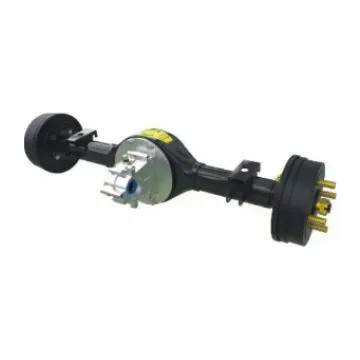
Integrated Rear Axle with Two Gears If you’re looking to upgrade your ride, fix a handling issue, or just make your daily drive a little nicer, we’re here to help. Hit us up to talk through your needs, whether it’s a daily driver, a weekend toy, or a race car. We don’t do one-size-fits-all—we build parts tailored to how you use your car.
References
- Gillespie, T.D. (1992). Fundamentals of Vehicle Dynamics. Society of Automotive Engineers.
- Jazar, R.N. (2017). Vehicle Dynamics: Theory and Application. Springer.
- Milliken, W.F., Milliken, D.L. (1995). Race Car Vehicle Dynamics. SAE International.
Jiangsu Changyun Drive Techniques Co., Ltd.
As one of the leading suspension manufacturers and suppliers in China, we offer a wide range of products with superior quality. Please rest assured to wholesale advanced suspension from our factory. If you have any enquiry about cooperation, please feel free to email us.
Address: Building B, 1st Floor, Chuangyan Port, Science and Education City, Wujin District, Changzhou City, Jiangsu Province
E-mail: eva@czbenma.com
WebSite: https://www.cyevenergy.com/
